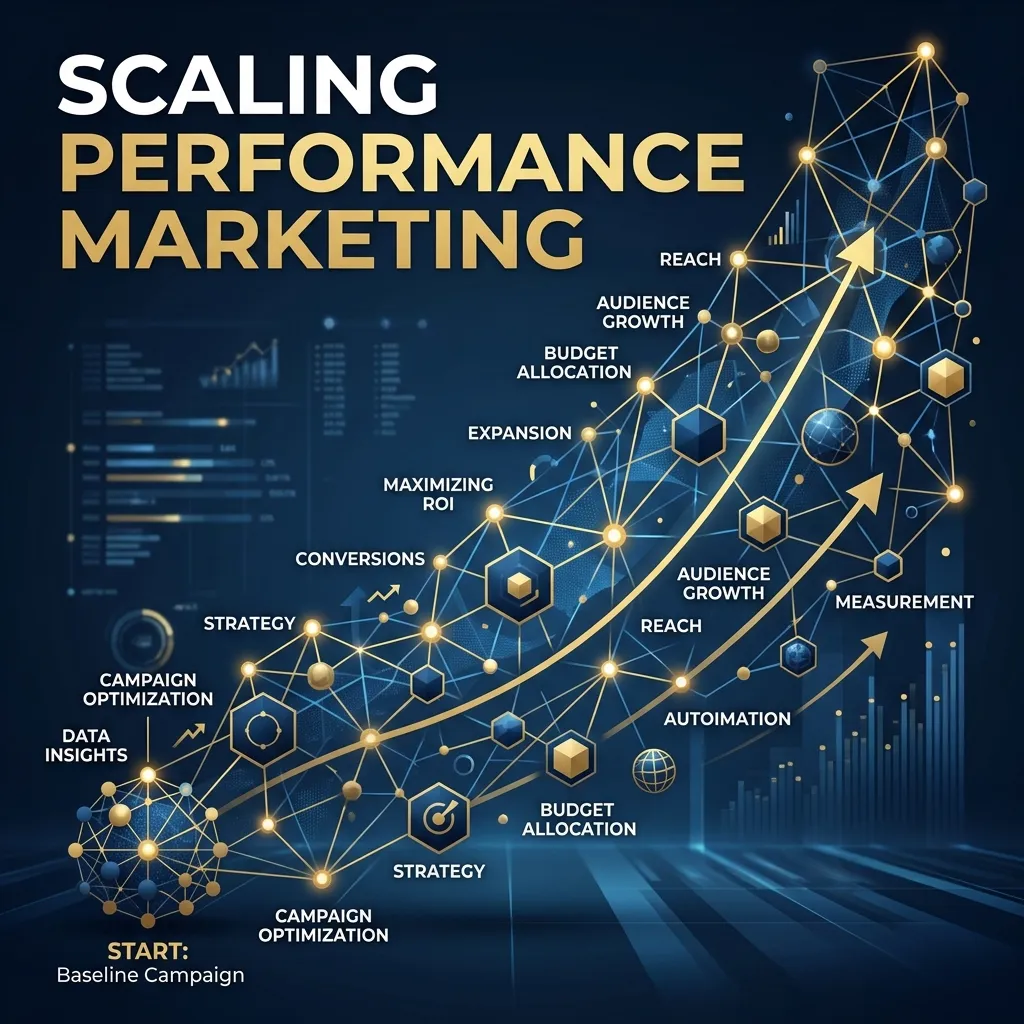
Scaling Performance Marketing in 2026: The Agentic AI Revolution
Digital marketing has evolved rapidly over the past few years, but nothing has disrupted the industry quite like the rise of Agentic AI. For brands looking to maximize their return on investment, adopting these autonomous systems is no longer a luxury. It is a strict necessity for survival in 2026. This comprehensive guide breaks down how Agentic AI works, why it matters, and how partnering with a specialized team can help you implement it effectively.
We will explore the shift from basic automation to true autonomous agency, the financial impact of predictive audience targeting, the changing role of the modern marketing agency, and the transition from traditional search engine optimization to Generative Engine Optimization.
The Core Mechanics of Agentic AI
While generative AI (like early versions of ChatGPT) required constant human prompting to produce copy or images, Agentic AI acts as an autonomous agent. When given a high-level goal, such as increasing e-commerce sales for winter jackets by 15% with a $10,000 budget, the Agentic AI system can independently research the market, generate ad copy, design creatives, launch the campaign across Meta and Google, and continuously adjust bids based on real-time performance.
This level of automation means that marketing teams can step away from the tedious, day-to-day management of ad accounts and focus on overarching brand strategy and customer experience. The system does not just follow a rigid set of rules. It learns, adapts, and executes multi-step workflows. If an ad creative begins to fatigue, the Agentic AI identifies the drop in click-through rate, analyzes which visual elements are failing, generates a new variation, and pushes it live. It handles the entire lifecycle of campaign management.
Moving Beyond Basic Generative Models
Basic generative models are static. You ask for a blog post, and you get a blog post. You ask for a Facebook ad headline, and you get a headline. The output is entirely dependent on the quality of the input, and the human operator is still responsible for testing, deploying, and measuring that output.
Agentic AI introduces feedback loops. It interacts with its environment. In the context of performance marketing, the environment is the ad platform (Google Ads, Meta Ads, LinkedIn Ads) and the website analytics. The agent reads the data, makes a decision, executes the decision, measures the outcome, and refines its next action based on that outcome. This continuous cycle of execution and optimization happens at a speed and scale that no human team could possibly match.
The Architecture of an Autonomous Marketing Agent
To understand how Agentic AI scales performance marketing, you have to understand its underlying architecture. A typical marketing agent consists of several interconnected modules.
First, there is the perception module. This component continuously ingests data from your CRM, Google Analytics, ad accounts, and even external market data. It looks for patterns, anomalies, and opportunities. For example, it might notice that a specific demographic in a specific geographic region is converting at a much higher rate during evening hours.
Second, the reasoning module takes over. It analyzes the data provided by the perception module and determines the best course of action to achieve the overarching goal. It evaluates multiple scenarios. Should it increase the bid for this specific demographic? Should it create a new ad variation tailored to evening shoppers? The reasoning module uses probability models to predict the outcome of each possible action.
Third, the execution module takes the decision and implements it. It interacts directly with the APIs of the ad platforms. It adjusts the bids, pauses underperforming ads, or publishes new creatives.
Finally, the learning module evaluates the result of the action. If the bid increase resulted in a lower cost-per-acquisition, the learning module reinforces that behavior. If the new ad variation failed, the learning module updates its models to avoid similar creatives in the future.
The Shift from SEO to AEO and GEO
Search engines have changed fundamentally. With Google integrating AI Overviews directly into search results, users no longer need to click through to a website to get answers. This has led to the rise of Answer Engine Optimization (AEO) and Generative Engine Optimization (GEO).
To rank in this new landscape, your content must be structured in a way that AI models can easily extract and cite. This means using clear, answer-first formatting, robust schema markup, and highly specific data points rather than vague marketing fluff. Working with an expert agency ensures your website is technically optimized for these AI crawlers.
Understanding Generative Engine Optimization
Generative Engine Optimization is about understanding how Large Language Models retrieve and synthesize information. When a user asks an AI search engine a question, the engine does not just look for keywords. It looks for authoritative, well-structured information that directly answers the query.
If you are a business trying to gain visibility, you cannot rely on old SEO tactics like keyword stuffing or buying low-quality backlinks. You have to become the authoritative source that the AI engine wants to cite. This requires a deep understanding of entities, semantics, and knowledge graphs.
Your content needs to clearly define the entities it discusses and the relationships between them. If you are a Best Performance Marketing Agency in Chennai, your website needs to explicitly state your location, your services, your industry expertise, and your client results. This information must be marked up with structured data (schema.org) so that the AI engine can easily parse it.
The Importance of Original Research and Data
AI engines prioritize original information. If your blog post just regurgitates the same generic advice found on a hundred other websites, the AI engine has no reason to cite you. You need to provide unique value.
This means publishing original research, case studies, proprietary data, and expert opinions. If you can provide a unique statistic or a counter-intuitive insight, the AI engine is much more likely to pull that information and cite your website as the source. This is how you drive traffic in 2026. You do not win by having the most content; you win by having the most citable content.
Answer-First Formatting
When structuring your content for AEO, you must adopt an answer-first approach. Anticipate the questions your target audience is asking and answer them directly and concisely at the beginning of your paragraphs or sections.
Use clear headings, bullet points, and numbered lists. AI models excel at extracting information from structured formats. If an AI engine has to parse through three paragraphs of metaphorical fluff to find the answer to a simple question, it will simply move on to a competitor's website. Provide the answer immediately, and then use the subsequent text to provide context, examples, and deeper analysis.
Real-World Impact: Driving ROI with Agentic Systems
Consider a mid-sized e-commerce brand that previously spent $20,000 a month on Facebook ads. Their internal team spent hours every week testing different creatives, pausing underperforming ads, and shifting budgets. The process was slow, prone to human error, and fundamentally limited by the number of hours in a day.
By integrating an Agentic AI solution, the system tested 150 variations of ad copy and imagery in real-time. It identified that users responding to video ads on mobile converted 40% higher on weekends. The AI autonomously shifted the budget to capitalize on this trend without any human intervention. The result was a 35% increase in total revenue and a 20% drop in cost-per-acquisition within the first month.
Case Study: B2B SaaS Lead Generation
Let us look at another example in the B2B SaaS space. A software company was struggling with high customer acquisition costs on LinkedIn. Their sales cycle was long, and their target audience was highly specific: Chief Information Security Officers at Fortune 500 companies.
Their traditional approach involved running broad awareness ads and hoping for the best. The results were dismal. They implemented an Agentic AI system designed to optimize for pipeline revenue, not just lead volume.
The AI agent analyzed the company's historical CRM data to identify the characteristics of their most profitable customers. It then integrated with LinkedIn's API to build highly targeted micro-segments. The agent autonomously generated personalized ad copy for each segment, highlighting specific security compliance features relevant to different industries.
Over a three-month period, the Agentic AI system ran thousands of micro-experiments, continuously refining the targeting and messaging. It paused ads that generated low-quality leads and doubled down on the combinations that resulted in booked sales calls. The company saw a 50% reduction in their cost-per-lead and a 120% increase in qualified pipeline revenue. The AI system uncovered targeting opportunities that the human team had completely overlooked.
Dynamic Budget Allocation
One of the most significant advantages of Agentic AI is its ability to manage budget allocation dynamically across multiple platforms. In a traditional setup, a marketing manager might allocate $5,000 to Google Ads and $5,000 to Meta Ads for the month. They review the performance at the end of the week and make manual adjustments.
An Agentic AI system looks at the entire ecosystem holistically. If it detects a sudden spike in high-intent search volume on Google, it can instantly reallocate budget from Meta to Google to capture that demand. If a specific TikTok ad goes viral and starts driving cheap conversions, the AI can immediately scale the budget for that specific ad while reducing spend on underperforming campaigns. This fluid, real-time budget management ensures that every dollar is spent where it will generate the highest return.
Restructuring the Modern Marketing Team
The integration of Agentic AI does not mean the end of the marketing team. It means a fundamental restructuring of roles and responsibilities. The days of hiring junior media buyers to manually adjust bids and create pivot tables are over. The modern marketing team needs to pivot towards strategy, governance, and creative direction.
From Operators to Architects
Marketers must transition from being operators of advertising platforms to architects of AI systems. Instead of spending hours clicking buttons in the Facebook Ads Manager, marketers will spend their time defining the goals, constraints, and parameters for the Agentic AI.
This involves deeply understanding the business model, unit economics, and target audience. The human marketer sets the overarching strategy: "We need to acquire new users with a lifetime value of at least $500, and our maximum allowable customer acquisition cost is $150. Focus on the North American market." The AI agent figures out the tactical execution required to achieve that goal.
The Rise of AI Governance
As these systems become more autonomous, the need for robust AI governance becomes critical. An unchecked AI agent optimizing purely for short-term conversions could inadvertently damage the brand's long-term reputation. For example, it might discover that aggressive, clickbait-style headlines generate the cheapest clicks, leading it to flood the market with off-brand messaging.
The human team must establish the guardrails. This involves defining the brand voice, setting strict creative guidelines, and implementing approval workflows for sensitive campaigns. Marketers must become experts in auditing AI decisions, understanding why the system took a specific action, and correcting its course when it deviates from the brand's core values.
Elevating Human Creativity
AI excels at pattern recognition, optimization, and scale. It struggles with genuine empathy, emotional resonance, and true creative breakthroughs. By offloading the quantitative, analytical tasks to the AI agent, the human team is freed up to focus on the qualitative aspects of marketing.
This means spending more time deeply understanding the customer's psychology, conducting qualitative research, and developing compelling brand narratives. The human marketers create the big, overarching campaign concepts, and the AI agents handle the micro-variations and distribution. The synergy between human creativity and machine execution is the defining characteristic of successful performance marketing in 2026.
The Data Infrastructure Required for Agentic Success
Agentic AI is only as powerful as the data it is fed. If your internal data infrastructure is a mess of siloed spreadsheets and disjointed platforms, the AI agent will make optimized decisions based on flawed data, leading to catastrophic results at scale.
To leverage these systems effectively, businesses must invest heavily in a robust, unified data architecture. This means implementing a Customer Data Platform (CDP) that aggregates first-party data from every touchpoint: website interactions, CRM records, email engagement, and offline sales. The CDP acts as the single source of truth for the Agentic AI.
Navigating Privacy and First-Party Data
In 2026, third-party cookies are a relic of the past, and privacy regulations like GDPR and CCPA are stricter than ever. Agentic AI relies heavily on first-party data to build its predictive models. Businesses must focus on value exchanges: offering genuine utility to customers in exchange for their data.
This means building strong loyalty programs, gated content experiences, and interactive tools that encourage users to share their preferences. The Agentic AI can then use this rich, deterministic data to model lookalike audiences and predict future buying behaviors without running afoul of privacy regulations. The companies that build the most robust first-party data assets will be the ones whose AI agents outperform the competition.
Predictive Analytics and Audience Modeling
One of the most powerful applications of Agentic AI is predictive audience modeling. Traditional marketing relies on reactive data. You look at who bought your product last month and try to target similar people this month.
Agentic AI uses predictive analytics to anticipate who is going to buy your product before they even realize they need it. By analyzing millions of data points across the customer journey, the AI can identify the subtle signals that indicate purchase intent. For example, it might notice that users who read a specific blog post, interact with a pricing calculator, and then return to the site three days later have an 85% probability of converting.
The AI agent can then autonomously create a highly specific retargeting campaign tailored exactly to that cohort, serving them an offer at the precise moment they are most likely to buy. This predictive capability fundamentally shifts marketing from a game of chance to a game of calculated probabilities.
Overcoming the Implementation Hurdle
Implementing Agentic AI is not as simple as flipping a switch. It requires a fundamental shift in mindset, technology, and organizational structure. Many businesses fail in their first attempt because they treat Agentic AI as a plug-and-play software tool rather than a paradigm shift.
The Problem with "Set It and Forget It"
The biggest mistake businesses make with AI in 2026 is treating it as a total replacement for human oversight. They deploy an autonomous agent, give it a budget, and walk away. This "set it and forget it" mentality almost always leads to wasted spend and brand dilution.
AI agents are hyper-optimizers. If you give an agent the goal of maximizing lead volume, it will find the absolute cheapest way to generate leads, often at the expense of lead quality. You might wake up to thousands of new leads, only to discover that none of them are qualified to buy your product. The human team must constantly refine the constraints and goals provided to the AI. If the goal is qualified pipeline revenue, the AI must be integrated with the CRM to receive feedback on which leads actually close.
Building the Right Tech Stack
You cannot run Agentic AI on legacy technology. Businesses must audit their marketing stack to ensure that their platforms offer robust, bi-directional APIs. The AI agent needs to be able to pull data out of a platform, analyze it, and push instructions back into the platform in real-time.
If your CRM or your email marketing software operates in a closed ecosystem that does not allow for seamless API integration, it becomes a bottleneck for the Agentic AI. Upgrading to open, API-first platforms is a necessary prerequisite for adopting autonomous marketing systems.
Partnering with Specialized Expertise
Given the technical complexity and strategic nuances involved, most businesses do not have the internal resources to build and manage Agentic AI systems from scratch. This is where partnering with specialized experts becomes crucial.
A dedicated performance marketing agency brings the enterprise-level AI tools, the engineering talent, and the strategic experience necessary to implement these systems successfully. They help you navigate the transition, avoid the common pitfalls, and ensure that the AI agent is aligned with your overarching business objectives.
Measuring Success in the Age of Autonomy
The metrics we use to evaluate marketing performance must evolve alongside the technology. When an Agentic AI system is autonomously managing thousands of micro-campaigns, traditional metrics like Click-Through Rate (CTR) or Cost-Per-Click (CPC) lose their relevance.
Shifting Focus to Business Outcomes
Marketers must shift their focus from proxy metrics (clicks, impressions) to actual business outcomes. The Agentic AI should be evaluated based on its impact on Customer Acquisition Cost (CAC), Lifetime Value (LTV), and overall Return on Ad Spend (ROAS).
If the AI agent is driving a higher CPC but acquiring customers who stay with the business twice as long and spend three times as much, the strategy is successful. The human team must ensure that the AI is optimizing for the right end-goal. This requires deep integration between the marketing data and the financial data of the business.
The Role of Incrementality Testing
With AI systems constantly optimizing across multiple channels simultaneously, it becomes increasingly difficult to determine exactly which touchpoint drove a specific sale. Traditional multi-touch attribution models are often inadequate for dealing with the complexity of Agentic AI.
The solution is continuous incrementality testing. The human team must design controlled experiments to measure the true causal impact of the AI's actions. This involves withholding a specific marketing channel from a control group and comparing their behavior to a test group. The results of these incrementality tests are then fed back into the Agentic AI to calibrate its understanding of true marketing ROI.
The Future of the Digital Ecosystem
The widespread adoption of Agentic AI is fundamentally reshaping the digital ecosystem. The barriers to entry for running sophisticated, multi-channel campaigns have been dramatically lowered, leading to an explosion of competition.
The Premium on Brand Equity
In a world where every business has access to autonomous optimization algorithms, tactical execution is no longer a competitive advantage. The algorithm levels the playing field. If everyone is running perfectly optimized campaigns, how do you stand out?
The answer is brand equity. The strength of your brand, the emotional connection you have with your customers, and the quality of your product become the primary differentiators. The companies that win in 2026 are the ones that use Agentic AI to handle the tactical execution, freeing up their human talent to build a brand that people actually care about.
The Evolution of the Consumer
Consumers are becoming increasingly savvy. They are bombarded with AI-generated content and highly targeted ads. They are developing an immunity to generic marketing tactics.
To cut through the noise, marketing must become radically personalized and genuinely helpful. Agentic AI enables this level of personalization at scale. By deeply understanding the individual preferences and context of each user, the AI can deliver highly relevant, timely experiences that feel less like advertising and more like a concierge service.
Next Steps for Your Business
If you want to stay ahead of your competitors, now is the time to audit your digital marketing strategy. The transition to Agentic AI is not a future possibility; it is a present reality.
Begin by evaluating your current data infrastructure. Are you collecting clean, unified first-party data? Do your marketing platforms communicate with each other seamlessly? Identify the repetitive, manual tasks in your marketing workflow that could be handed over to an autonomous agent.
Consult with experts to build a transition plan. Partnering with a specialized team allows you to leverage cutting-edge technology without disrupting your core business operations. Embrace the shift from operator to architect, and position your business to thrive in the era of autonomous marketing.